A Conversation About Florida's Schools: The Education Interview
Key moments
A 40-year Miami-Dade educator on school choice: "You say that the parent can choose. It's really a false choice."
"Florida's families are leaving public schools because our politicians have abandoned our public schools." The teachers who remain do it out of love and passion for the craft.
"When you have schools take a voucher but charge tuition on top of it, we're abandoning the very families choice was supposed to help."
CONTEXT
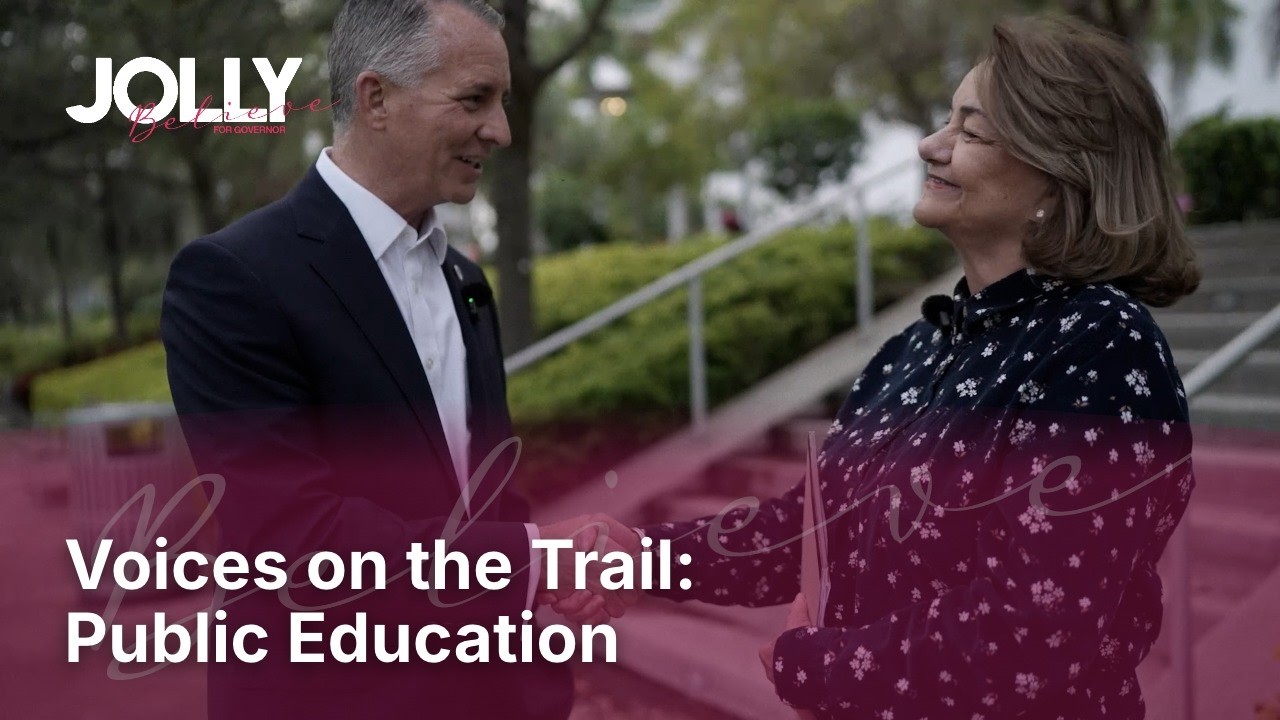
This is a real conversation, not a stump speech. David Jolly sits with a 40-year Miami-Dade educator and listens to what she has watched happen to Florida's public schools. The exchange runs under two minutes. It says a lot.
WHAT'S SAID
The through-line is simple. Florida hasn't lost a competition. It has abandoned the field. See the video at 0:43 for the argument that properly funded public schools would win in a school choice environment, and at 1:15 for who is actually profiting from the current system. For the full 10-year renaissance plan, see the Public Education issue page.
Transcript
Verified transcript of the video above.
Related questions
Isn't school choice good for parents?
School choice as a principle has broad support. The question is how it's structured. Florida's universal voucher program (HB 1, 2023) gave every family, regardless of income, access to public dollars for private school. About 69% of new voucher recipients after the 2023 expansion were already enrolled in private schools, meaning the program is largely subsidizing existing tuition payers rather than expanding access for kids who couldn't afford private school before[1]. See the video at 0:43 for David Jolly's argument that properly funded public schools would win the choice.
Don't vouchers help low-income families afford private school?
The original scholarship program was targeted at low-income families and worked as intended for that population. The 2023 universal expansion removed income limits, and the result skewed heavily toward families already in private schools. About 69% of new voucher recipients after HB 1 were already enrolled in private schools, meaning the expansion functioned as a tuition subsidy rather than expanding low-income access[1]. This is the concern the educator names in the video at 0:24 when she calls it a "false choice."
Does Jolly want to eliminate vouchers entirely?
No. His position is structural reform, not elimination. Voucher-accepting private schools would be required to provide the same specialized services public schools provide, cap tuition inflation for voucher students, and the program would be means-tested for demonstrated economic need[2]. The goal is to make voucher dollars do what they were originally promised to do: expand access for kids who otherwise couldn't attend private school. See the video at 1:03.
What is the "10-year renaissance" plan?
"Public schools have been inadequately funded in Florida for decades," Jolly says. The renaissance has three parts: dramatically increase investment in public schools, build more public schools in more neighborhoods, and pay more teachers more[2]. The 10-year framing is deliberate. This is a generational investment, not a one-cycle budget fix. For the full plan, see the Public Education issue page.
Sources
- Florida Senate, HB 1 (2023), https://www.flsenate.gov/Session/Bill/2023/1 · 2023-03-27
- David Jolly, Saving Our Schools , https://davidjolly.com/saving-our-schools · 2024-01-01
This isn't a debate about choice. It's a fight for Florida's kids.
Have a question for David? Visit the Town Hall and ask.